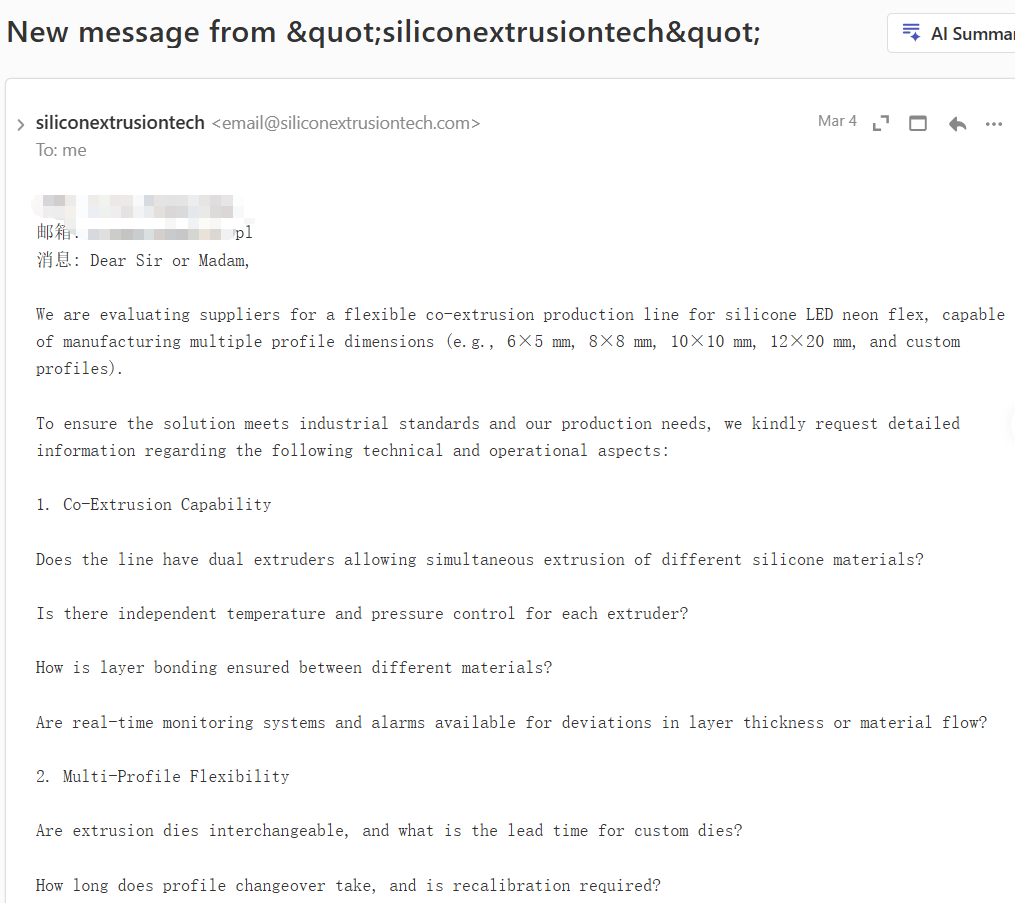
I am Eason. This morning, I opened my email and found a very detailed inquiry. The customer is evaluating suppliers for a flexible silicone co-extrusion production line. They want to know everything. They asked about profile dimensions like 6×5 mm and 12×20 mm. They asked about dual extruders, layer bonding, and CE certification for the European market. This is not a basic buyer. This is a professional who knows the hardware. When I saw these questions, I smiled. I love it when a customer challenges me with deep technical details. It reminds me of when I play basketball with a team that is better than mine. I have to play my best. I have to be precise.
I live in China with my wife and my two sons. My older son is very interested in how things are made. He often looks at my technical drawings and asks why the machines have so many wires. I tell him that every wire is like a nerve in the human body. It carries information to the brain, which is the PLC. In 2026, a high-end LED silicone strip extrusion machine must be smart. It cannot just be a motor and a screw. It must be a complete, synchronized system that can handle different sizes and materials without making a mess. This blog post is my direct answer to that inquiry. If you are also looking for a silicone co-extrusion production line, this guide will help you understand what to look for.
A professional LED silicone strip extrusion machine must offer multi-profile flexibility and perfect co-extrusion control to meet 2026 industrial standards. You need a system that can switch from a small 6×5 mm profile to a large 12×20 mm profile quickly. You need dual extruders with independent pressure and temperature controls to ensure a perfect molecular bond between different silicone layers. This allows you to create dot-free, IP68-rated neon flex with integrated LED centering and real-time monitoring. By choosing a line with high automation and CE compliance, your factory can reduce scrap rates and provide the high-quality lighting that the European and global markets demand.
1. Mastering the Co-Extrusion Capability for Multi-Material Strips
The first part of the inquiry asks about dual extruders. Yes, a modern LED silicone strip extrusion machine must have at least two extruders. Some even have three. This allows you to extrude different materials at the same time. For example, you can use a high-reflectivity white silicone for the base and a high-transparency silicone for the top. This is the only way to get high light efficiency. If the extruders are not independent, you cannot control the flow properly. Each material has a different viscosity. White silicone is “heavier” because of the pigment. Clear silicone is “lighter.” You need independent pressure and temperature control for each one.
I want to dive deeper into the control logic of dual extruders because it is the “heart” of the co-extrusion process. In our LED silicone strip extrusion machine, we use high-precision pressure sensors right before the mold entrance. These sensors tell the PLC exactly how much force the silicone is exerting. If the pressure in the white silicone extruder drops by even 0.2 bar, the system automatically increases the motor speed to fix it. This happens in real-time. Without this, the layers will not bond correctly. The layer bonding happens inside the “fusion zone” of the mold. In 2026, we use a specialized “pre-heat” stage inside the mold core to keep the silicone active. This ensures that the two materials weave together at a molecular level before they hit the vulcanization oven. We also include real-time monitoring systems. These are like the “eyes” of the machine. We use laser micrometers to measure the thickness of the strip as it leaves the mold. If the top layer gets too thin, an alarm sounds. This prevents you from making 100 meters of bad product. I tell my sons that you must watch the ball at all times when you play basketball. The machine must watch the material at all times. This is the difference between a professional line and a cheap one. I have seen many factories in Poland and Russia struggle because their extruders were not synchronized. My hardware process solves this problem before it starts.
2. Achieving Multi-Profile Flexibility and Quick Changeovers
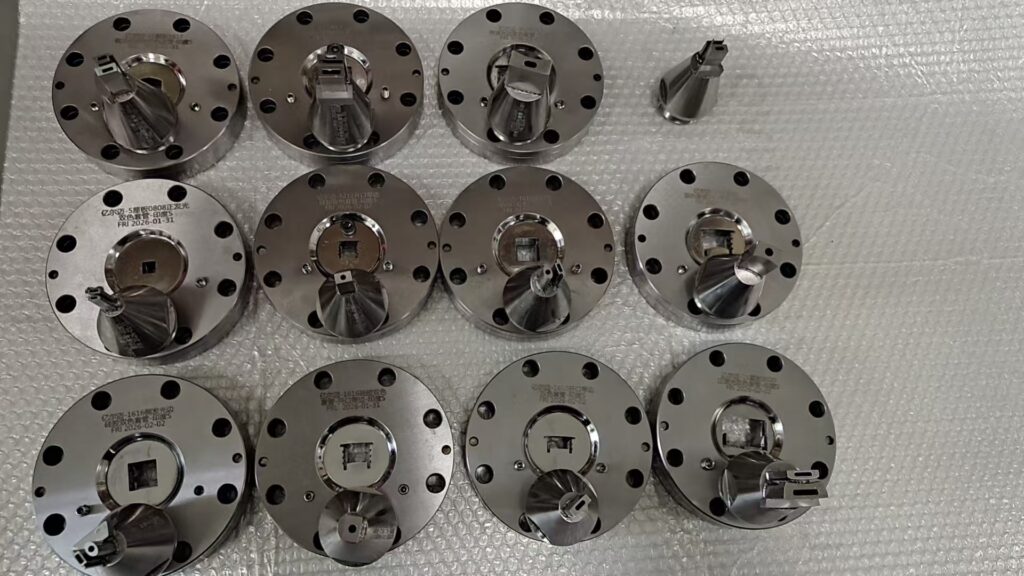
The customer asked about dimensions like 6×5 mm, 10×10 mm, and 12×20 mm. They also asked about changeover times. This is a very important point for a busy factory. In 2026, you cannot afford to spend a whole day changing a mold. You need a flexible LED silicone strip extrusion machine. We design our lines so that the extrusion dies are easily interchangeable. We use a “quick-lock” system for the mold plates. This means you don’t have to unscrew twenty bolts every time you want to change the profile.
I want to dive deeper into the economics of profile changeovers. In a standard factory, a mold change often takes four to six hours. During this time, the machine is not making money. Our LED silicone strip extrusion machine reduces this to less than 60 minutes. We do this by using a standardized mold base. You only change the internal core and the die plate. Everything else stays the same. For custom profiles, our lead time for new dies is usually two to three weeks. This is because we use in-house CNC machining. We test every die before we ship it. Regarding recalibration, our PLC stores the “recipes” for each profile. If you switch from 8×8 mm to 12×20 mm, you just load the 12×20 recipe. The machine automatically sets the motor speeds, the oven temperatures, and the puller tension. This means you only need a few minutes of fine-tuning. The dimensional tolerances for our profiles are within +/- 0.1 mm for small sizes and +/- 0.15 mm for larger ones. This precision is necessary because if the profile is too big, it won’t fit into the aluminum mounting clip. If it is too small, it looks cheap. I like hiking because I have to follow the trail exactly. If I miss the turn by even a few meters, I am lost. In extrusion, precision is your trail. If you miss the tolerance, your profit is lost. I ensure that every LED silicone strip extrusion machine I sell has this level of flexibility. It allows my clients to take on small, custom orders as easily as big, standard ones.
3. Ensuring Quality through Vacuum Degassing and Shore Hardness Control
The third part of the inquiry is about quality. The customer is worried about air bubbles and dot-free effects. This is a common worry. Silicone is a thick material. When it is mixed or pumped, air gets trapped inside. If you extrude this air, you get “pearls” or bubbles inside your neon flex. This looks terrible when the light is turned on. A professional LED silicone strip extrusion machine must have a vacuum degassing system. This pulls the air out of the silicone before it enters the screw barrel.
I want to dive deeper into the degassing and optical quality process. In our line, we use a high-vacuum chamber that sits between the material pump and the extruder. This chamber pulls a deep vacuum of -0.09 MPa. This makes any trapped air bubbles expand and pop. This is how we ensure that the finished 1615 or 1212 neon flex is perfectly clear. For the “dot-free” effect, it is about the “opacifying agent” in the silicone. We help our clients find the right mix ratio. We also use a “tri-layer” co-extrusion mold if needed. This adds a very thin, highly diffusive layer on the very top of the strip. This layer breaks up the light from the LEDs so you see a solid line of light. Regarding Shore hardness, it is very important to keep it consistent. If the silicone is too soft, the strip will sag. If it is too hard, it will crack when you bend it. We maintain Shore hardness by controlling the temperature of the vulcanization oven very strictly. If the oven is too hot, the silicone “over-cures” and becomes brittle. We use a multi-zone heating system. Each 2-meter section of the oven has its own sensor and heater. This creates a perfect “curing curve.” I tell my sons that baking a cake is about the oven temperature. If it is too high, the outside burns and the inside is raw. My LED silicone strip extrusion machine “bakes” the silicone perfectly from the inside out. This is how we maintain the same Shore hardness across a 500-meter roll of material. It is about the hardware and the science working together.
4. Advanced LED Integration and PCB Protection
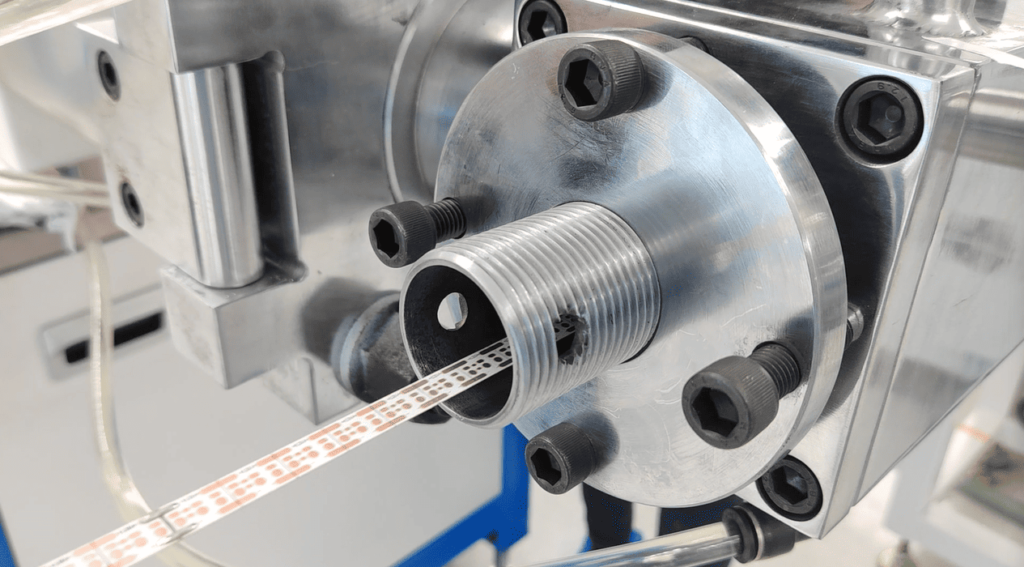
The customer wants to know if the line can automatically feed and center the LED PCBs. The answer is yes. This is a core feature of an integrated LED silicone strip extrusion machine. In 2026, nobody should be “hand-feeding” LEDs into a machine. We use a specialized “pay-off” machine that holds the PCB reel. This machine has a tension controller. It makes sure the PCB is not pulled too hard, which could break the copper circuits. The centering happens inside the extrusion mold.
I want to dive deeper into the LED centering and testing hardware. Inside the mold, we have a “guiding slot.” This slot is CNC-machined to match the width of your PCB, whether it is 8 mm, 10 mm, or 12 mm for RGBW. The silicone flows around the PCB from both sides at the same time. This equal pressure keeps the LED strip right in the middle. If the pressure is not balanced, the PCB will “drift” to one side. This makes the light look uneven. We also include inline LED testing. We use a low-voltage power supply that touches the PCB before it enters the mold. If there is a “dead” diode, an alarm sounds and the machine stops. This is much better than finding a dead LED after you have already used 50 meters of silicone. Our system is compatible with various PCB widths and even with flexible “zigzag” PCBs. The co-extrusion process protects the LEDs by “encapsulating” them. The silicone acts like a shock absorber. It protects the diodes from displacement during the pulling process. I love playing basketball because teamwork is everything. The extruder, the mold, and the PCB pay-off must work like a team. If one is too fast, the strip fails. I spend a lot of time during the 14-day on-site training showing workers how to align the PCB guide perfectly. It is a small detail that saves thousands of dollars in scrap. When the LED is centered, the 1212 profile glows perfectly. This is the quality that wins big contracts in Europe.
5. Automation, PLC Architecture, and Technical Support
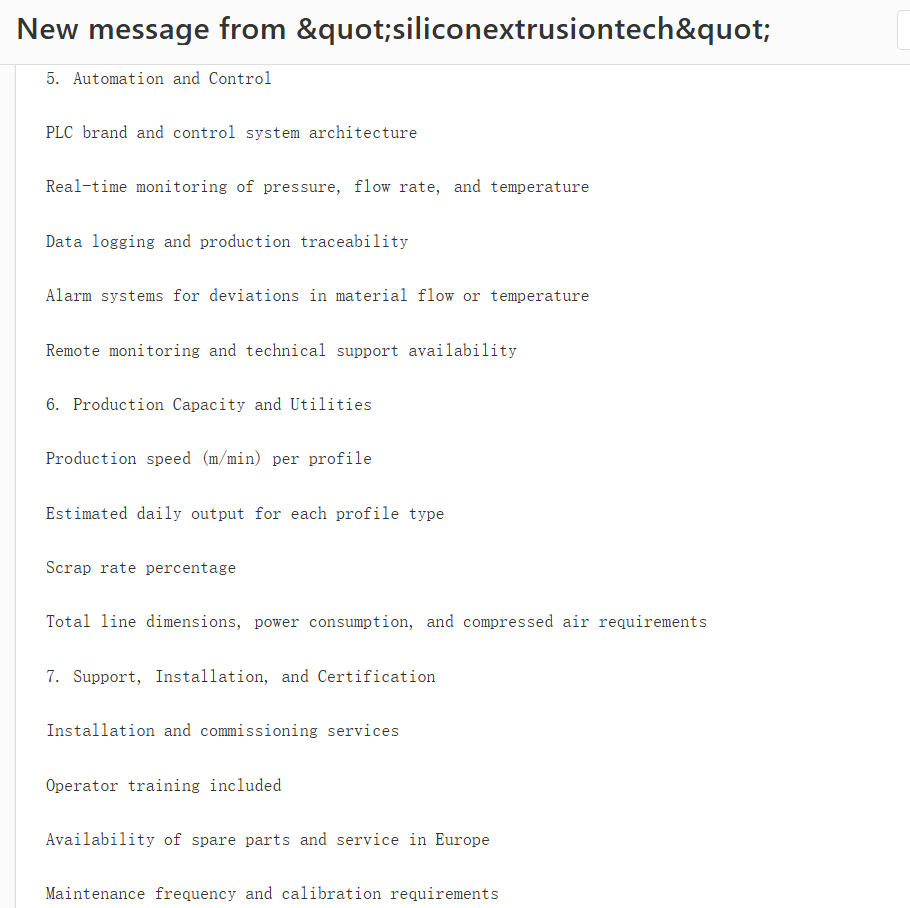
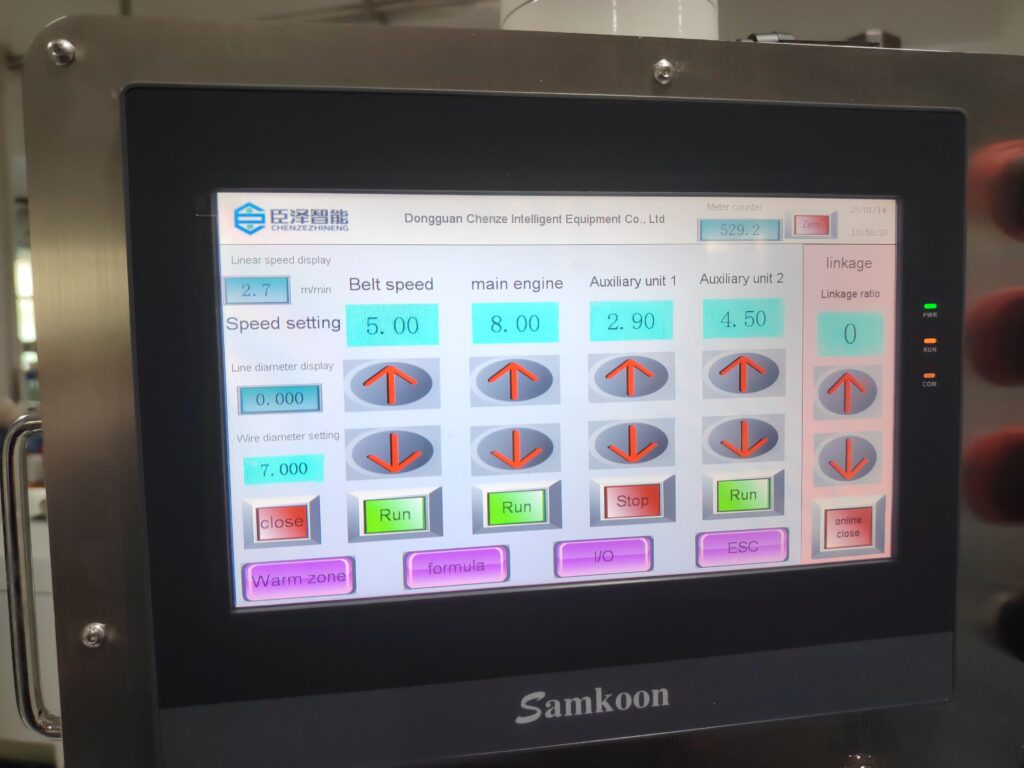
The final technical part of the inquiry is about the “brain” of the machine. The customer asked about the PLC brand and data logging. In 2026, a factory needs data to be efficient. We use Siemens or Delta PLCs as our standard. These are reliable brands with parts available all over the world. The architecture is built on a high-speed industrial network. This allows all the parts of the LED silicone strip extrusion machine to talk to each other in milliseconds.
I want to dive deeper into the automation and traceability features. Every LED silicone strip extrusion machine we sell comes with a data logging module. This system records the pressure, the flow rate, and the temperature every second. This data is saved to a local server or the cloud. If a customer in Europe says their batch of neon flex is “too soft,” you can go back and look at the data for that day. You can see if the oven temperature dropped. This is “production traceability.” It is essential for high-end manufacturing. We also offer remote monitoring. If you have a problem in Poland, I can log into your machine from China. I can see the sensor readings and tell your engineer what to adjust. This saves a lot of time and money on travel. The alarm system is also very smart. It does not just beep; it tells you exactly what is wrong on the touch screen. For example, it might say “Zone 4 Heater Failure” or “Extruder 2 Pressure High.” This makes troubleshooting much faster. I like to read about new software and hardware because it helps me stay ahead. My sons are already better at using tablets than I am. I want my machines to be just as easy to use. By using a world-class PLC and offering remote support, we bridge the gap between China and the rest of the world. We make sure you are never alone when you are running your production line.
6. Production Capacity and European Certification
The last part of the inquiry is about the “business” side. The customer wants to know about speed, scrap rate, and CE certification. In 2026, the speed of an LED silicone strip extrusion machine is usually between 4 to 8 meters per minute. This depends on the size of the profile. A small 6×5 mm profile can run very fast. A big 12×20 mm profile needs more time in the oven to cure, so it runs a bit slower. The estimated daily output is between 4,000 and 8,000 meters for a 24-hour shift.
I want to dive deeper into the utilities and the scrap rate. A well-tuned LED silicone strip extrusion machine should have a scrap rate of less than 3%. Most of this scrap happens during the start-up when you are waiting for the temperatures to stabilize. Once the machine is running, it should produce perfect strips for hours. Regarding power, a full line usually needs about 60 to 100 kW, depending on the oven length. You also need compressed air for the vacuum systems and the cooling air knives. The total line length is about 25 to 35 meters. For our European clients, CE certification is mandatory. We design our machines to meet all EU safety standards. This includes emergency stop buttons, safety covers for moving parts, and shielded electrical cabinets. We provide all the necessary documentation for your local safety audits. I am proud to provide installation and commissioning services. I come to your factory. I set up the machine. I train your team. I stay for 14 days because I want to see your first 5,000 meters of perfect product. I don’t just sell hardware; I sell a successful production start. My advanced extrusion solutions are ready for the global stage. I know the technical hurdles and I have the answers.
Conclusion: Building a Partnership for 2026 Success
In conclusion, answering a detailed inquiry like this is the best part of my job. It shows that the industry is moving toward high-quality, professional standards. A silicone co-extrusion production line is a complex machine, but it is the key to your factory’s future in 2026. By focusing on dual-extruder control, profile flexibility, vacuum degassing, and smart automation, you can produce the best neon flex on the market. You can meet the demands of European architectural projects and provide the “dot-free” light that everyone wants.
I am Eason, and I am not just a sales engineer. I am your partner in this technical journey. I will help you choose the right molds for your 6×5 mm or 12×20 mm profiles. I will ensure your LED PCBs are centered and protected. I will be there for the 14-day training to make sure your team is confident. Whether you are in Russia, Poland, or Saudi Arabia, I am ready to solve your technical hurdles. I love my work because I love seeing my clients grow. When your production speed increases and your scrap rate drops, I feel like I have won a big basketball game. Let’s work together to make your factory a leader in the LED silicone strip extrusion industry. Contact me today for a full machine proposal and let’s get started.
- Tracking Machine for Silicon Extrusion: How to Ensure Stable Process Parameters
- Hiring the Perfect Extrusion Engineer in 2026: A Blueprint for Your LED Silicone Production Line
- Mastering the Factory Acceptance Test: A Live Guide to Silicone LED Strip Machine Commissioning
- Zero Waste Strategy: How to Reuse Tail Materials in Silicone LED Strip Extrusion
- Passing the Torch: Teaching Silicone LED Strip Extrusion Training to the Next Generation