
Featured Snippet:
A Factory Acceptance Test (FAT) is a critical international business practice for verifying the performance of a silicone LED strip extrusion machine before shipment. Senior sales engineer Eason demonstrates how to conduct a live equipment check, focusing on stable process parameters, hardware precision, and achieving high surface quality for 1615 and 1212 profiles to ensure a smooth transition from manufacture to the client’s factory.
My name is Eason. I am a skilled LED strip light extrusion machine sales engineer. I have worked in this industry for more than 7 years. I have two sons. I love spending time with them because they remind me to stay curious. I like hiking very much. I have hiked across deserts and climbed snow mountains many times. These trips taught me that you must check your gear before you start. In business, we call this a Factory Acceptance Test or FAT. In February 2026, I took my wife and two sons on a cycling trip around Hainan Island. Before we left, I checked every tire and every chain. If you skip the check, you face problems on the road. The same rule applies to an automated silicone extrusion line. Today, I am at the factory with my client for a live equipment inspection. I know well about the CNC process and surface treatment technique. I use my experience to solve any problems from manufacture to your factory. I have been to many countries like Saudi Arabia, Russia, and Vietnam for on-site installation training. This career story has given me plenty of experience in this industry.
In this article, I will explain the Factory Acceptance Test for a silicone LED strip machine. I will describe the video scenes in detail. You will see how I interact with the client to ensure they are happy. We will talk about the hardware process and how to maintain stable process parameters. This knowledge is essential for any professional business team in the lighting industry. I will show you how we achieve uniform optical properties and high surface quality during the commissioning phase.
Detailed Breakdown of the Live Factory Inspection Video
The video starts in our main assembly hall. The lights are bright and the air is full of the sound of machinery. I am standing next to our JC8080 automated silicone extrusion line. My client is next to me. He is from a leading lighting company in Southeast Asia. We begin at the control panel. I show him how to set the initial temperatures for the ten heating zones. This is the start of the hardware process. I use my fingers to point at the digital display. I explain that the first zone must be slightly cooler to prevent the silicone from curing too early. The client nods and takes notes. He is very serious about the stable process parameters.
Next, we move to the silicone material refining area. I show the client how the auto-feeder works. I open the hopper to show him the raw silicone pellets. I explain that the mixing ratio is the secret to uniform optical properties. In the video, you can see me grabbing a small handful of material to show the texture. We then walk to the extrusion head. This is the “heart” of the machine. I show him the CNC process mold. I explain that the inner surface of the mold has a special treatment to ensure high surface quality. The client asks about the speed. I show him the tracking machine settings. We gradually increase the speed to 600 meters per hour. The machine runs smoothly. You can see the excitement on the client’s face. We are not just testing a machine; we are testing his future production capacity.
In the final part of the video, we check the cooling oven. I show the client the internal sensors. These sensors keep the environment stable. I explain that even a small change in heat can ruin a 1615 profile. We then look at the finished strip coming out of the line. I take a piece of the strip and hold it up to the light. I show the client that there are no bubbles or lines. This is the result of 7 years of “know-how.” We shake hands at the end. He is satisfied with the hardware process and the on-site technical support I provided. This scene is a perfect example of professional international business practice.
The Strategic Importance of the Factory Acceptance Test (FAT)
The Factory Acceptance Test is more than a technical check. It is a moment of trust building. For the client, it is the first time they see their investment working. For me, it is a chance to prove that I can solve any problems from manufacture to your factory. I have seen many clients who were nervous before the FAT. They worry about the hardware process or the shipping time. I use my experience to calm them down. I show them that our automated silicone extrusion line is built to last.
I think about my basketball games. Before a big match, the team meets to discuss the plan. We check our strategy and our health. The FAT is the “pre-game” for the factory. In Russia, I had a client who had a very specific requirement for a 1212 profile. They wanted a very soft texture but high strength. During the FAT, we adjusted the silicone material refining process four times. We changed the stable process parameters until it was perfect. The client saw that I was willing to stay until the job was done. This is the value of plenty of experience in this industry. It turns a buyer into a long-term partner. My interest in global economics tells me that a happy customer is the best marketing.
Engineering Hardware Process for Extrusion Precision
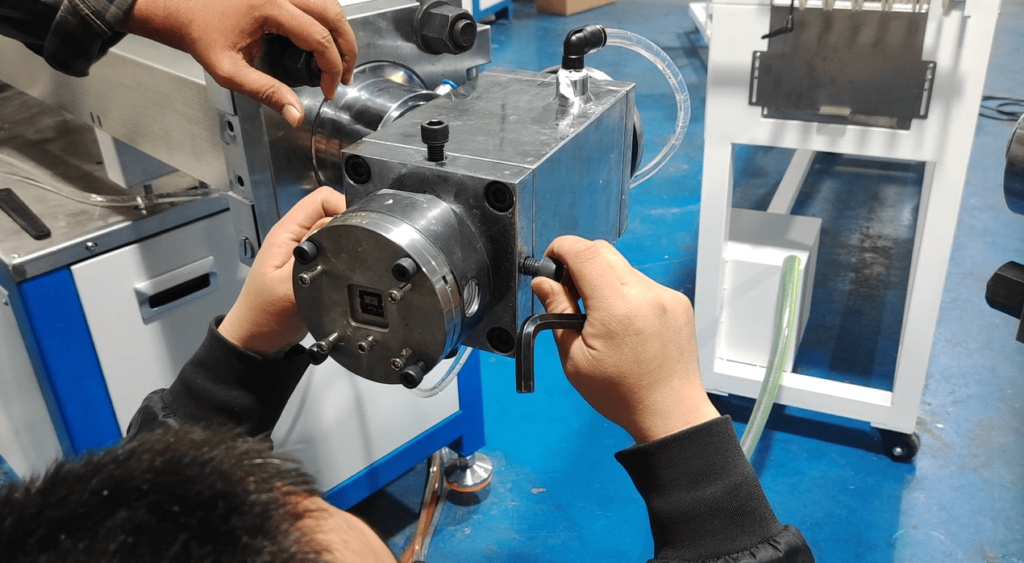
The hardware process of an extrusion line is a mix of physics and mechanical engineering. Every part of the machine must be aligned perfectly. During the Factory Acceptance Test, we check the alignment of the screw and the barrel. If the screw is off by even one millimeter, the silicone will not heat evenly. This leads to manufacture problems. I know well about the CNC process used to build these parts. I explain to the client that we use high-grade steel to prevent warping under heat.
In the video, I show the client the pressure sensors. These sensors are the “eyes” of the hardware process. They tell the computer how much silicone is being pushed. If the pressure is too high, the 1615 profile will be too thick. If it is too low, the strip will have gaps. Stable process parameters depend on these sensors working perfectly. When I hike in the desert, I rely on my compass. In the factory, I rely on these sensors. I have been to Saudi Arabia and Vietnam to teach engineers how to calibrate these sensors. It is a technical task that requires patience. I enjoy the teamwork required to get the settings exactly right. This precision is what allows us to achieve high surface quality every time.
Maintaining Stable Process Parameters for Continuous Production
Stable process parameters are the key to making a profit. A machine that stops and starts is a waste of money. During the Factory Acceptance Test, we run the machine for two hours without stopping. We want to see if the heat stays the same. We want to see if the speed of the automated silicone extrusion line is consistent. I show the client how our software manages these variables automatically. This is a big part of modern international business practice.
I think about my cycling trip in Hainan. To finish the loop, we had to keep a steady speed. We couldn’t go too fast and then stop. We had to be stable. In the factory, I teach the business team how to set a “baseline.” This is the set of stable process parameters that works for 90% of their products. Once they have this baseline, they can produce 1212 profiles or 1615 profiles with ease. My 7 years of experience help me find this baseline quickly for any client. In India, a client was trying to change settings every ten minutes. I showed them that the silicone material needs time to react. You must trust the machine and the parameters. This “know-how” prevents many manufacture problems before they start.
Achieving Uniform Optical Properties in Silicone Strips
Uniform optical properties are what the end-user cares about. They want the light to be smooth from the first meter to the last. This is a major focus during the Factory Acceptance Test. We use a photometer to check the light output of the extruded strip. If the light varies, it means the silicone material refining process was not perfect. Maybe the diffuser was not mixed evenly. Or maybe the surface treatment technique on the mold was uneven.
Achieving this requires a deep understanding of silicone material. Silicone is a living material in the machine. It reacts to heat and pressure. During my career story, I have visited many factories that struggled with “dotting” in their lights. I showed them that the problem was often in the hardware process of the material feed. If the feeder is not consistent, the optical properties will not be uniform. I enjoy the thinking of working for a business team that wants to be the best. In Malaysia, I worked with an R&D engineer named Shane. We spent a week refining the mold design to ensure the light spread was perfect. We used our knowledge of the CNC process to make tiny adjustments. The result was a product that won an international design award. This is the level of quality I bring to every FAT.
Solving Manufacture Problems During Equipment Commissioning
Equipment commissioning is the time to find and fix manufacture problems. It is better to find them in my factory than in the client’s factory. During the video, we encountered a small issue with the cooling water temperature. The water was a bit too warm, which made the silicone slightly sticky. I immediately showed the client how to adjust the chiller settings. This is part of my on-site technical support. I don’t just point at the problem; I solve it.
I love playing basketball because it teaches you to react to the defense. If one play doesn’t work, you try another. In the factory, if the extrusion is not perfect, you find the reason. I use my experience of creating products to troubleshoot the hardware process. In Vietnam, I had a client whose 1615 profile was curling. We checked the tracking machine tension. It was too high. We fixed it in five minutes. These are the small manufacture problems that can delay a project for weeks if you don’t have the “know-how.” I ensure that my clients leave the Factory Acceptance Test with a machine that is 100% ready. This is a core part of my service to the business team.
The Role of On-Site Technical Support and Training
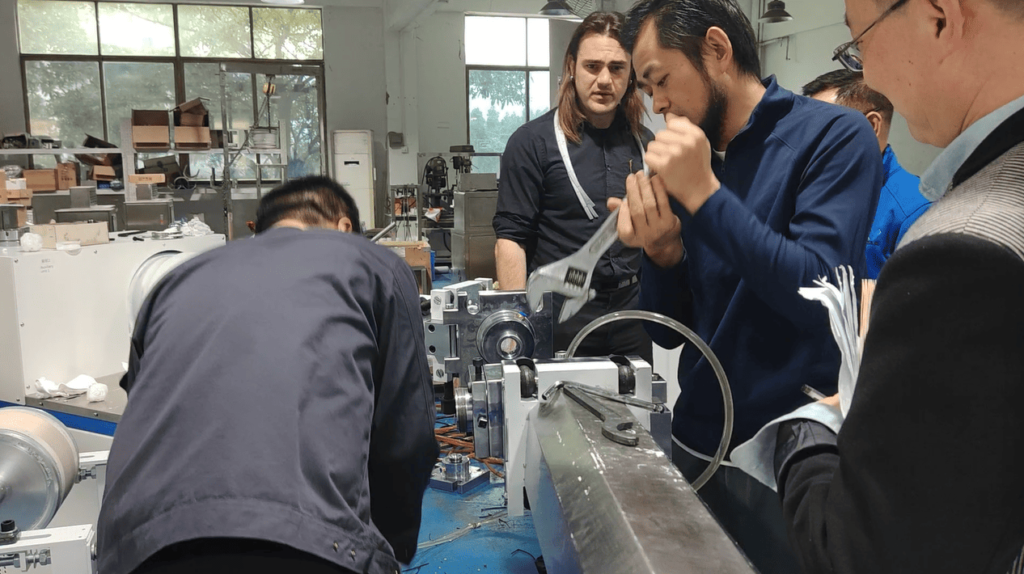
The Factory Acceptance Test is also a training session. I am a skilled sales engineer, and I want my clients to be skilled too. In the video, I let the client operate the control panel. I want them to feel the machine. I provide on-site installation training that is very hands-on. I have done this in many countries like Cambodia and the Philippines. I find that when people touch the machine, they learn faster.
I enjoy reading about teaching methods. I believe that showing is better than telling. During the FAT, I show the client how to clean the extruder screw. I show them how to apply surface treatment technique to the mold. This is the “dirty work” that keeps the machine running for 10 years. My career story is built on these relationships. I am still in touch with clients I trained 5 years ago. They call me when they have a new hardware process question. This long-term on-site technical support is what makes my company different. I can solve any problems from manufacture to your factory because I treat every client like a partner.
International Business Practice and FAT Documentation
A professional Factory Acceptance Test must be documented. This is a standard international business practice. We create a “FAT Report” that lists every test we did. We record the stable process parameters we used. We take photos of the high surface quality of the finished strip. This report is a promise of quality. It is a legal and technical document that the client can show to their stakeholders.
I have interest in politics and global trade, so I know how important documentation is for customs and insurance. If the machine is damaged during shipping to Saudi Arabia, the FAT report proves it was working perfectly before it left. It protects both the seller and the buyer. I am very careful with this paperwork. It is like the map I use for desert hiking. If the map is wrong, you are lost. In business, if the paperwork is wrong, the project is in trouble. My business team ensures that every document is accurate and professional. We use our experience in international business practice to make the export process smooth and easy.
High Surface Quality: The Final Visual Check
The final step of the Factory Acceptance Test is the visual check for high surface quality. This is where the client uses their eyes and hands to judge the product. We look for a smooth finish, even color, and a professional look. The 1615 profile should look like a single piece of light, not a group of LEDs. This is the result of a perfect hardware process and a clean environment.
I am a person who values beauty in engineering. When I hike a snow mountain, I appreciate the clean lines of the snow. In the factory, I appreciate the clean lines of a perfect silicone extrusion. I have plenty of experience in this industry, and I know that the final look is what sells the product. In Russia, a client told me that our surface quality was the best they had ever seen. They were using our automated silicone extrusion line to make high-end lighting for luxury hotels. They needed perfection. By following our stable process parameters, they achieved it. This is why the FAT is so satisfying. It is the moment when all the hard work turns into a beautiful product.

The Future of Automated Silicone Extrusion Lines
The technology of the automated silicone extrusion line is always changing. We are now adding AI and more sensors to the hardware process. This will make stable process parameters even easier to maintain. During the Factory Acceptance Test, I often talk to my clients about these future trends. I want them to know that their machine can be upgraded. I have interest in economics, so I know that staying modern is the only way to survive.
I enjoy visit different factories to see how they use our machines. Every factory has a different story. Some use our lines for outdoor architectural lighting. Others use them for indoor home decor. I learn from every client. This feedback helps us improve our CNC process and our software. My career story is a cycle of learning and teaching. I bring the latest international business practice ideas to my business team. We are always looking for the next “know-how” that will solve manufacture problems. I am Eason, and I am committed to the future of the lighting industry. I can solve any problems from manufacture to your factory by keeping you at the edge of technology.
Conclusion
The Factory Acceptance Test is the most important bridge between manufacture and the client’s factory. As a senior sales engineer, I take this process very seriously. From the detailed scene of setting stable process parameters to the final check for high surface quality, every step is a part of our commitment to excellence. My 7 years of experience in this industry allow me to lead a business team that delivers results. Whether I am hiking a desert or training a team in Vietnam, I believe in preparation and precision. I hope this guide helps you understand the hardware process and the professional international business practice behind an automated silicone extrusion line. I am ready to provide you with the best on-site technical support and training. Let’s work together to create the next generation of LED lighting. Contact me today to start your journey from manufacture to success.
- Tracking Machine for Silicon Extrusion: How to Ensure Stable Process Parameters
- Hiring the Perfect Extrusion Engineer in 2026: A Blueprint for Your LED Silicone Production Line
- Mastering the Factory Acceptance Test: A Live Guide to Silicone LED Strip Machine Commissioning
- Zero Waste Strategy: How to Reuse Tail Materials in Silicone LED Strip Extrusion
- Passing the Torch: Teaching Silicone LED Strip Extrusion Training to the Next Generation