I am Eason. I have worked as an LED strip light extrusion machine sales engineer for more than five years. This job is my passion. It is not just about selling a machine. It is about solving real problems in the factory. I have seen many factories struggle with complex setups. Today, I want to talk about one of the most difficult tasks in our industry. That is the setup of a 3-color LED silicone strip extrusion machine.
Last month, I was on-site helping a team. It reminded me of my personal life. I have two sons. I love to take them on adventures. In February 2026, I took my wife and my two sons for a cycling trip around Hainan Island. It was a long journey. We had to work together as a team. If one person was tired, we all slowed down to help. This is exactly like a business team or a production line. In basketball, which I also love to play, teamwork is everything. You cannot win alone. You need the right person in the right place. My experience in CNC processes, hardware, and surface treatment helps me be that right person for my clients. I know how to bridge the gap between a Chinese manufacture and your local factory.

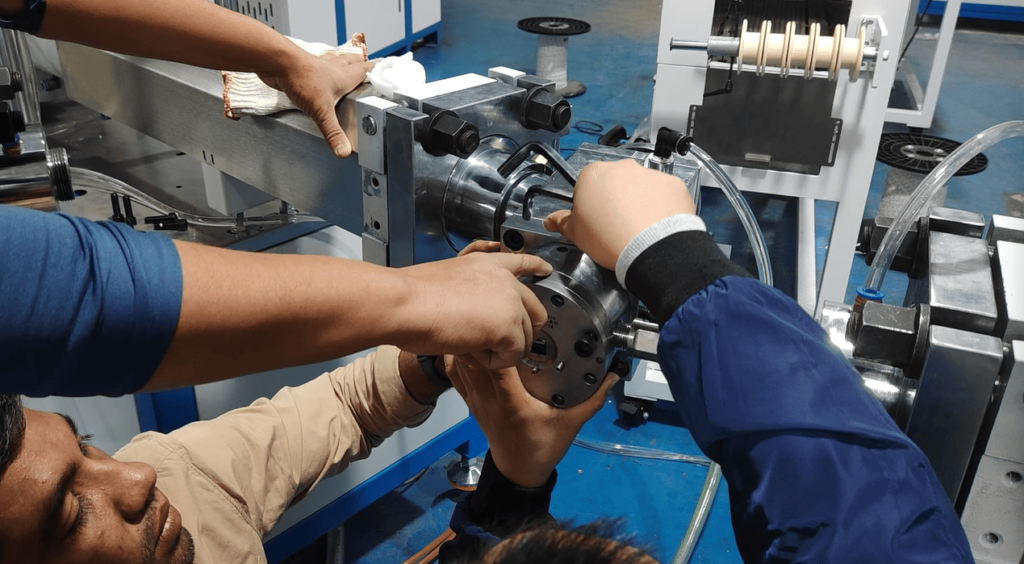
The video I am sharing today shows a very special project. We were in India. We were working with a local engineering team. The goal was to install a complex three-color LED silicone strip extrusion machine. This is not a standard machine. It uses three separate extruders. They all feed into one single mold. If the speed is off by just a little bit, the colors will mix poorly. The product will be waste. My job is to make sure that does not happen. I use my knowledge of international business and manufacturing to ensure a smooth start.
The Technical Core of the LED Silicone Strip Extrusion Machine
A 3-color LED silicone strip extrusion machine is a marvel of engineering. Most people think a machine is just a metal body. I always tell my clients that the machine is the body, but the mold is the heart. For this project, we used 1615 and 1212 profiles. These are common sizes, but adding three colors makes them very hard to produce. You have three independent screw barrels. Each one has its own torque and speed. They must be perfectly synchronized.
When I was hiking snow mountains, I learned about balance. If you lean too far left or right, you fall. Extrusion is the same. The silicone flow must be balanced. If one extruder pushes too hard, it will block the others. This creates “backflow.” Backflow ruins the internal structure of the LED strip. During the 14 days of on-site training in India, I spent hours teaching the local technicians how to “feel” the flow. You cannot just look at the screen. You must watch the material as it leaves the mold.
I have spent a lot of time visiting different factories. I have seen how CNC processes affect the quality of the mold. A cheap mold will never give you a clean line between colors. That is why I oversee the hardware process myself. I want to make sure the surface treatment inside the mold is perfect. This reduces friction. Less friction means a smoother flow and a better product. My background in creating products helps me see these small details that others miss.
Why Teamwork and Precision Matter in Manufacturing
In my five years in this industry, I have traveled to Saudi Arabia, Russia, and Poland. Every country is different, but the machines stay the same. What changes is the people. Success comes from the business team working together. This is why I enjoy playing basketball so much. You have to think about the next move. You have to communicate. In India, we worked long hours with the R&D engineer, David. He wanted a perfect product. We had to adjust the electronic control and the mechanical flow at the same time.
It is like my desert hiking trips. You have to plan for everything. You need to know your equipment. You need to know your limits. When we set up the LED board feeding system, we had to be very careful. If the board is not centered, the light will be uneven. We checked the alignment many times. We ensured there were no material gaps. A gap means moisture can get in. Moisture kills LED strips.
My interest in politics and economics helps me understand the global market. I know that manufacturers need to be competitive. A machine that breaks down is not competitive. That is why I provide full support. I solve problems from the manufacture stage all the way to your factory floor. I want your production to be continuous. I want you to win in your local market.
The Synchronization of Three Independent Extruders
Synchronizing three extruders is the biggest challenge for any engineer. Each extruder handles a different color or type of silicone. Usually, one is for the base, one is for the side color, and one is for the top translucent layer. These materials might have different viscosities. This means they do not move at the same speed even if the motors are set the same. You have to adjust the RPM of each screw barrel individually.
I remember my cycling trip in Hainan. My sons have smaller bikes. They have to pedal faster to keep up with me and my wife. We had to find a rhythm that worked for everyone. In the LED silicone strip extrusion machine, the “rhythm” is the pressure inside the mold. We use pressure sensors to monitor this. But sensors can fail. That is why I teach technicians to use manual adjustments. You look at the thickness of each color. If the red is too thin, you increase the speed of that specific extruder.
The torque of the motor is also very important. If the silicone is cold, the torque goes up. High torque can break the screw. We use high-quality hardware and CNC-machined parts to ensure the machine can handle the pressure. My knowledge of surface treatment also helps here. We treat the screws to make them wear-resistant. This extends the life of the machine. I don’t just sell you a machine and leave. I make sure your team knows how to maintain this balance. This is the difference between a high-end factory and a low-end one.
Mastering Mold Calibration for 1615 and 1212 Profiles
The mold for a 3-color LED silicone strip extrusion machine is incredibly complex. It is a co-extrusion mold. This means three paths meet in one small space. The geometry must be perfect. If the CNC process is off by 0.01mm, the colors will bleed into each other. You will not get a sharp line. I have visited many mold factories to understand this. I know what a good mold looks like.
During the installation in India, we focused on the 1615 profile. This is a popular size for neon flex. We had to align the three paths so the LED board sits exactly in the middle. If it sits too low, the bottom will be too hot. If it sits too high, the light will be dim. We use a special feeding guide. This guide must be adjusted while the machine is running. It is a “huge work,” as I said in the video.
I often think about my hiking trips when I do this. When you are climbing a snow mountain, every step must be placed carefully. If you are sloppy, you put yourself in danger. Calibrating a mold is the same. You cannot rush it. You adjust one screw, wait for the material to come out, and then check the result. It takes 7 to 14 days to get it right. But once it is set, the machine can run for weeks without stopping. This precision is what I bring to your factory. I use my experience to ensure that the final product is something you can be proud of.
Solving Global Manufacturing Challenges with Local Expertise
International business is more than just shipping a box. It is about understanding the local environment. When I go to Poland or Saudi Arabia, the power supply might be different. The humidity might be different. Silicone is very sensitive to temperature and humidity. My background in economics helps me understand the cost of downtime. If your machine is not working, you are losing money.
I solve problems from my manufacture to your factory. This means I check everything before it leaves China. I look at the hardware. I check the electronic components. I make sure the software is easy to use. When the machine arrives, I am often there to help. I am not just a sales engineer; I am a partner. I bring the expertise that David and his team in India needed. They had the talent, but they needed the specific “know-how” of this machine.
This reminds me of playing basketball. You can have the best players, but if they don’t have a coach, they might lose. I act as that coach for your technical team. I translate complex technical terms into simple actions. I show them how to clean the machine. I show them how to swap the colors. I make sure they understand the “why” behind every step. This creates a productive force that lasts long after I leave. My goal is to make sure your factory is self-sufficient. I want you to be the leader in your region for LED silicone strips.

Conclusion
Building a successful production line for LED silicone strips is a journey. It requires the right LED silicone strip extrusion machine and the right partner. I am Eason, and I am here to be that partner. My five years of experience and my passion for teamwork ensure that your project will succeed. Whether it is a cycling trip with my family or a complex machine installation in India, I give 100%. I know the CNC process. I know the hardware. I know how to manage a business team. Let’s work together to create something great. We will solve every problem from the manufacture to your factory. Your success is my success.
- Tracking Machine for Silicon Extrusion: How to Ensure Stable Process Parameters
- Hiring the Perfect Extrusion Engineer in 2026: A Blueprint for Your LED Silicone Production Line
- Mastering the Factory Acceptance Test: A Live Guide to Silicone LED Strip Machine Commissioning
- Zero Waste Strategy: How to Reuse Tail Materials in Silicone LED Strip Extrusion
- Passing the Torch: Teaching Silicone LED Strip Extrusion Training to the Next Generation