
As we move into 2026, the LED linear lighting industry is undergoing a revolution—shifting from “visible light dots” to “pure linear light.” As a sales engineer with years of experience in the extrusion equipment field, I (Eason) have observed a clear shift during my factory visits in Poland, Russia, and Saudi Arabia. Clients are no longer satisfied with traditional SMD (Surface Mounted Device) strips; they are now laser-focused on the combination of COB (Chip-on-Board) strips and silicone sleeves.
This “Golden Duo” has not only solved the “pixelated” pain point of traditional neon flex but has also taken a dominant position in the 2026 smart lighting and high-end decor markets.
The core trend for 2026 is this: COB strips, with their ultra-high-density chips, paired with the soft diffusion of silicone extrusion sleeves, achieve true “dot-free, ultra-thin, and high-brightness” linear lighting. Compared to traditional SMD solutions, the COB + Silicone combo increases the beam angle to 180° and improves heat management efficiency by over 20%. It is the premier choice for high-precision architectural projects and luxury retail displays.
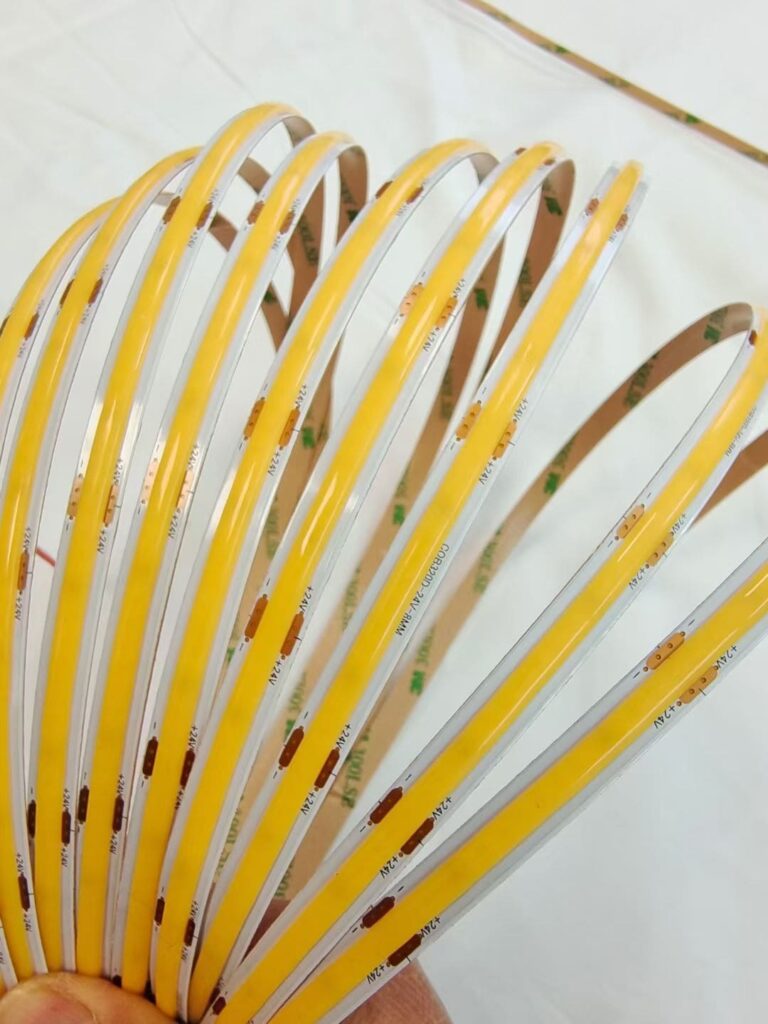
Trend 1: The Evolution from “Point Light” to “Seamless Linear Light”
Before 2025, to eliminate the “rib cage effect” (light spots) of SMD strips, we usually had to increase the thickness of the silicone extrusion layer. However, this brought two problems: reduced light flux and increased material costs.
In 2026, the maturity of COB technology has made chip spacing almost disappear. When this high-density strip is inserted into a silicone sleeve:
- No Need for Thick Diffusion Layers: Even with an ultra-thin silicone sleeve, perfect uniform light output is achieved.
- Ultra-Thin Design: This makes ultra-slim neon flex like 1010, 0808, or even smaller sizes possible, perfectly fitting the minimalist aesthetic.
I often tell my two sons that, just like LEGO, the smaller the parts, the more detailed the model. COB is that detailed part, and the silicone sleeve is the perfect protective coat for it.
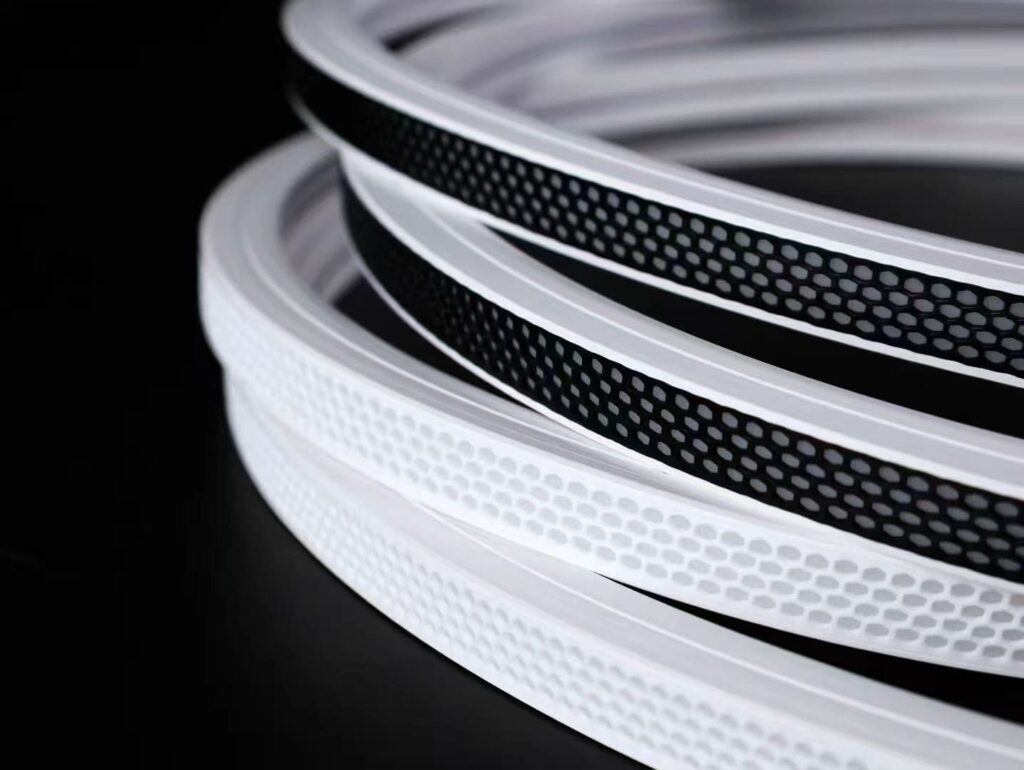
Trend 2: The Versatility of Silicone Sleeving (Hollow Extrusion)
Why is the market in 2026 leaning toward silicone sleeves rather than full solid extrusion for COB?
- Maintenance and Repairability: In markets like Poland and Germany that value sustainability, a sleeve solution allows for the internal LED strip to be replaced without destroying the outer housing.
- Thermal Expansion Buffer: Although COB strips have better heat dissipation, they still generate heat in confined spaces. The tiny air gap inside the silicone sleeve provides a buffer for thermal expansion and contraction, preventing PCB damage caused by pressure.
As a basketball player, I know the importance of “cushioning.” Just as knees need braces, LED strips need silicone sleeves—a professional “protector” that is both flexible and UV-resistant.
Trend 3: Synergistic Optimization of Heat Management and Efficiency
Global energy regulations in 2026 (such as the new EU energy efficiency standards) place higher demands on light efficiency (lm/W).
- Direct Heat Dissipation: COB chips are mounted directly onto the PCB, resulting in lower thermal resistance.
- Silicone’s Thermal Stability: Unlike PVC, silicone remains extremely stable between $-50^{\circ}\text{C}$ and $150^{\circ}\text{C}$. This combination ensures that even under high-power operation, the strip’s lifespan can exceed 50,000 hours.
For clients in high-temperature regions like Saudi Arabia, I specifically recommend the “High-Power COB + High-Transparency Silicone Sleeve” solution. This ensures the lights stay cool and do not yellow even during tropical nights.
Trend 4: Integrated Automation of Sleeve Production and Strip Insertion
As an engineer passionate about hardware and CNC technology, I’ve noticed that 2026 production processes are evolving. Current LED silicone extrusion machine solutions can now achieve high-speed sleeve production or even online insertion automation.
- Production Speed: Our lines can now stably produce high-quality silicone sleeves at $6\text{–}8\text{ m/min}$.
- Precision Control: Using PLC to control the internal diameter tolerances of the sleeve ensures the COB strip fits perfectly—neither too loose nor too tight.
Market Advice for 2026
If you are a factory owner considering equipment investment for 2026, my advice is: Do not stay with old PVC lines. Move directly into “Cold Extrusion, Heat Forming” silicone equipment. As COB strip prices continue to drop in 2026 (expected to be 30% lower than 2023), “COB + Silicone” will no longer be a premium product but the industry standard. Through my 14-day on-site training, your team can quickly master the matching of these two cutting-edge materials.
Do you want to know how to design the most suitable silicone sleeve mold for COB strips? Or do you need a quotation for a 2026-ready silicone extrusion line? Feel free to contact me anytime. Let’s lead the smart lighting wave together!
Learn more about COB Silicone Extrusion Solutions
- Hidden Cost Analysis: 5 Ways a Low-Price Silicone Extruder Will Kill Your Factory Profits in 2026
- 2026 Maintenance Guide: How to Extend the Life of Your High-Precision Silicone Extrusion Molds
- 2026 LED Silicone Extrusion Industry Trends: The Perfect Fusion of COB LED Strips and Silicone Sleeves
- Why is the mold the heart of your LED silicone strip extrusion machine success?
- 5 Key Differences Between Silicone and PVC Extrusion Machines: Why Your Factory Must Switch to Silicone in 2026